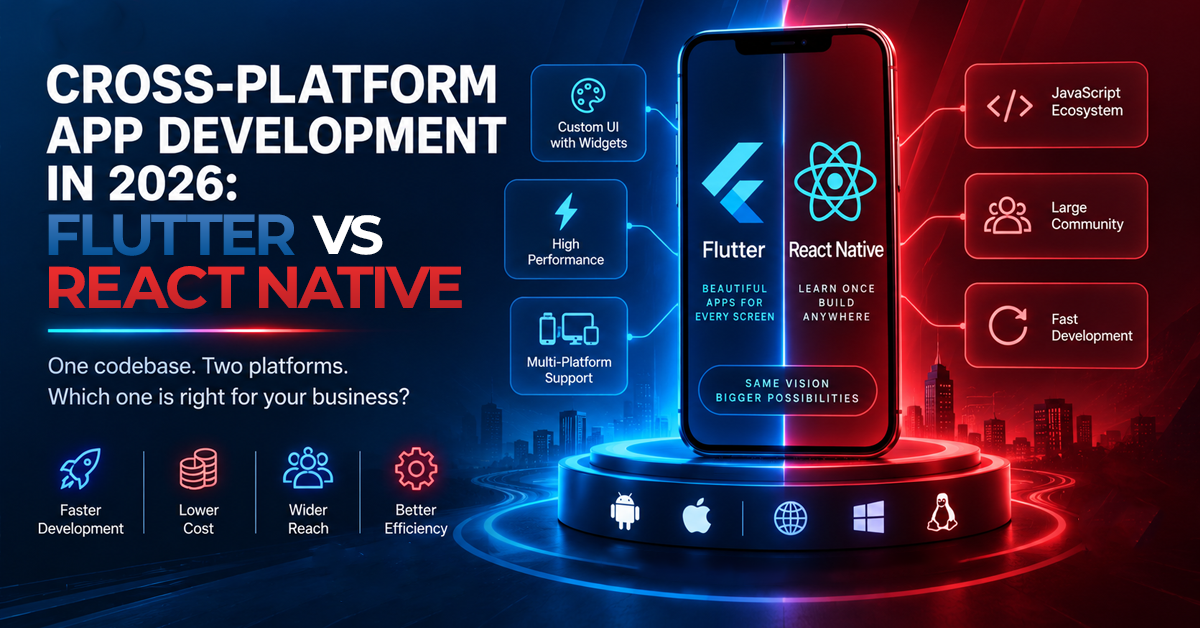
 Mobile App Development
One app. Two platforms. A wrong decision may cost you time and cause development delays. For launching an application for iOS and Android, writing code is just not enough. The other crucial aspects that need attention are framework, design, updates, and performance. If you develop two separate applications, your cost will eventually be multiplied. So what comes up as a combined solution? Cross-platform app development! It helps startups, small businesses, and established businesses to launch iOS and Android apps with a shared codebase. This helps to reduce repetitive work for developers without compromising on user experience. Flutter and React Native are two leading frameworks in cross-platform app development in 2026. Both operate in their own ways. But which one should you use for your next business application? This blog highlights what cross-platform app development is and the major differences between Flutter and React Native to help you pick the best one for your business app.
According to Market Research, the global market for cross-platform app development is expected to reach $458.1 billion by 2032. The development strategy of building a single application for iOS and Android is cross-platform app development. It allows developers to use a single codebase for each app. It can save time and cost. This is the reason why businesses prefer cross-platform development for applications.
Flutter is among the leading platforms for cross-platform app development. It uses Dart as its programming language and its own widgets to create the UI. Flutter is also best for creating hybrid apps. Flutter development framework puts developers in complete control of the appearance and behavior of the interface. Not constrained by any of the native UI elements a platform provides. Flutter development has a stateful hot reload feature. This feature integrates the main code into the machine for launch on supported platforms. It means that developers can easily make quick changes. With this, they can monitor the features, design, and performance during the app development process. Its platform reach is another big advantage. Flutter officially supports Android, iOS, web, Windows, macOS, and Linux. So, for companies wanting a single technology to cover multiple types of apps, Flutter's a solid option.
Managed and developed by Meta, React Native completely depends on React. With React Native, developers use JavaScript and TypeScript to build high-quality mobile applications for iOS and Android platforms. Why? The reason is that JavaScript is commonly used for web development. A company that has web developers may find React Native easy to adopt. Their developers don't have to leave the same ecosystem to build mobile apps. According to Propel Tech, React Native holds approximately 42% of the cross-platform app development market. Moreover, React Native has a large community, so developers will find multiple libraries, integrations, and tools for mobile app development.
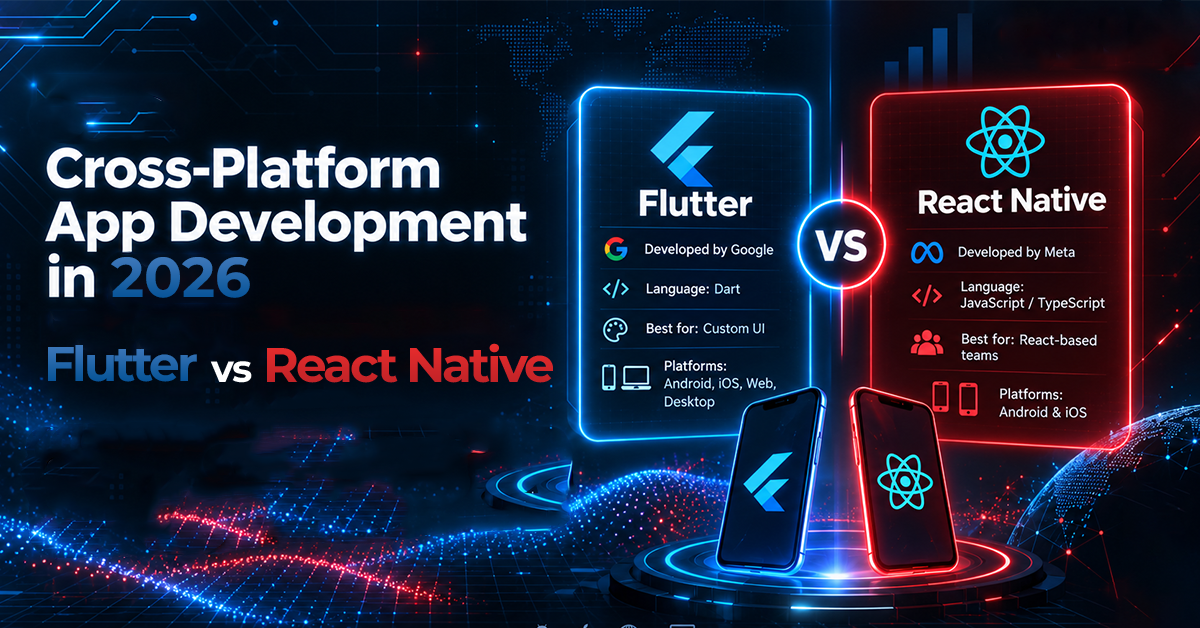
Below is a table showing the main differences between Flutter and React Native for applications.
| Feature | Flutter | React Native |
|---|---|---|
| Developed by | Meta | |
| Language | Dart | JavaScript / TypeScript |
| UI approach | Flutter widgets | React components |
| Code sharing | High | High |
| Android & iOS | Yes | Yes |
| Performance | Excellent | Excellent |
| Best for | Custom UI and multi-platform products | Teams already using React |
Whatever development framework you choose. Performance is one of the common things companies ask about. Flutter and React Native are both best for building excellent mobile applications. But performance depends on the application, the code, the libraries, and design. Flutter is considered when developers want more control over the changes and UI. Its architecture is built around its own rendering system, and Flutter continues to focus heavily on smooth performance across platforms. React Native has also made major improvements over the years. Its newer architecture, updated developer tools, and ongoing performance work have helped it remain a strong choice for demanding applications. For a normal business app, either framework can perform very well.
For UI interface and design flexibility, Flutter stands out. It allows developers to use custom widgets and controls for the interface. This makes it important for products that need strong visuals and branding.
Want unusual animations? A highly customized dashboard? A completely unique design system?
Flutter is highly preferred. But React Native is flexible. It works well with native components and is suitable for applications that require native performance and feel. Although different applications have features that can be built with Flutter, apps for a native feel can be good with React Native.
For development speed, both cross-platform mobile app frameworks are excellent. The reason behind this is an existing codebase. Hot reload is one of the important features of Flutter. It allows developers to amend the code and see the results. This saves time during the testing process. On the other hand, React Native is preferred by teams with knowledge of JavaScript, TypeScript, and React. This is where your existing team matters. A company with experienced React developers, such as AdamIS Tech, may build faster with React Native. A team that already knows Dart and Flutter may naturally move faster with Flutter. The framework alone doesn’t determine your development speed. Your people do.
You can’t exactly say which one is best. When building highly customised interfaces with detailed attention to the visual aspects of your application and requiring deployment to desktop, web, and mobile, Flutter may be the better choice. If you are already considering React and related tools like JavaScript and/or TypeScript and you want to develop a mobile app, but not from scratch. React is a good option. Another factor is the budget. Although cross-platform app development helps avoid much redundant development, the total cost of the cross-platform app depends on many factors. It includes the app's complexity, integrations, required tests, and team structure. It’s worth noting that even with both frameworks, native development is never entirely off the table. The nature of the application means that some features or integrations will fall outside the realm of React or Native.
For launching an application, both the options Flutter and React Native are good. Between the two, Flutter is suitable if you need a high-quality and consistent UI. But if your developers have a grip on languages such as TypeScript or JavaScript, it is good to go with React Native. However, the selection depends on the features and framework you need. When making the final call, do not just look for the technology. Consider who will use the app, platforms required, complexity of your user interface, third-party services to be employed, and the native features needed for your product. If you are looking for the best cross-platform app development company, partner up with AdamIS Tech. Here, we help you implement your idea and develop a scalable app for your business.
DELIVERING DIGITAL RESULTS, YOU DESIRE
READY TO HAVE A CONVERSATION?
WE'RE JUST A MESSAGE AWAY!

Define your goals and identify areas where we can add value to your business.
LET'S TALK ABOUT
YOUR PROJECT
Connect with us directly and get personalized guidance every step of the way.