 Mobile App Development
Your mobile phone knows what you want to buy, where you usually visit, and what your interests are. And that is just the start. Before AI, mobile apps required manual user input. Users had to type, search, and navigate through the mobile app to find a specific product, service, or information. But with the invention of AI. Everything has changed. Mobile apps with AI integration are smarter and more connected to users. They gather data, analyze information, learn your behavior, and make decisions quickly. Many technologies, including AI/ML, 5G, AR/VR, IoT, and low-code development, are changing what mobile applications will look like. With all these trends, companies are defining their approach to mobile app development. Instead of just using AI for search, businesses are integrating it for intelligence in their mobile apps. In this blog, we’ll discuss the key AI mobile app development trends in 2026. Also, we’ll explore the benefits and costs of AI mobile app development.
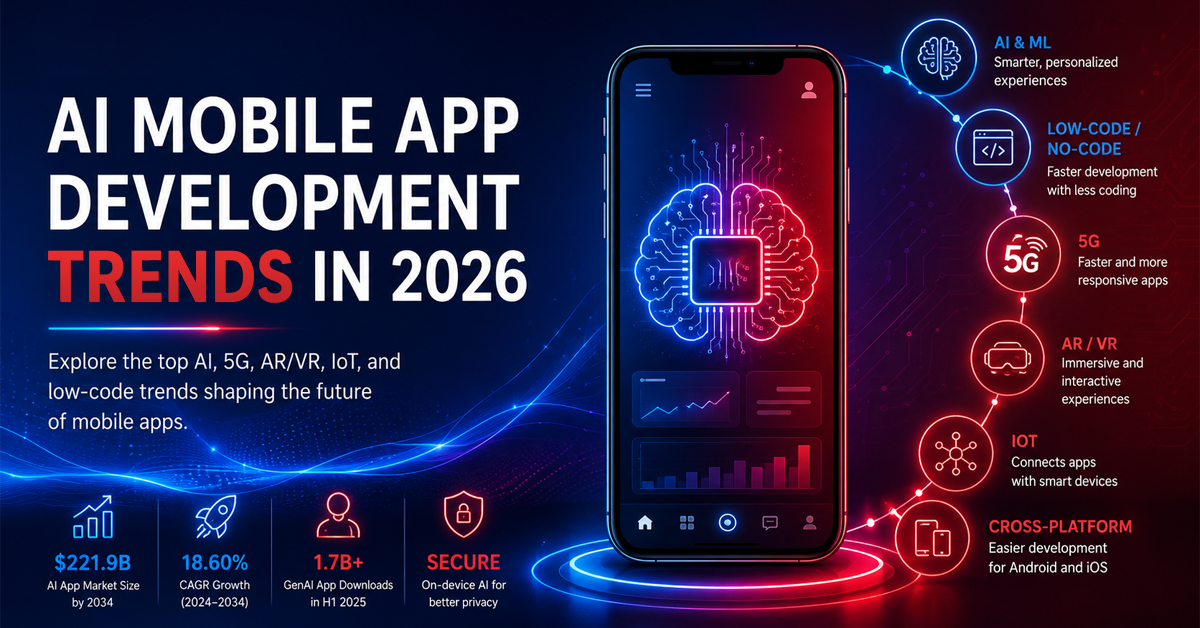
According to Market.US, the AI app development market size is expected to hit $221.9 billion by 2034, growing at a CAGR of 18.60%. AI mobile app development trends are changing the way users respond to mobile apps. Here are some of the top AI mobile app development trends in 2026. For more mobile app development trends and what’s coming next, have a look at our blog on the future of mobile app development..
| Trends | How It’s Changing Mobile Apps |
|---|---|
| AI & ML | Smarter, personalized, and automated experiences |
| Low-Code/No-Code | Faster app development with less coding |
| 5G | Faster and more responsive real-time apps |
| AR/VR | Immersive and interactive experiences |
| IoT | Connects apps with smart devices |
| Cross-Platform Development | Easier development for Android and iOS |
Artificial intelligence and machine learning have become common parts of business mobile apps. AI helps mobile apps learn user behavior, manage tasks, and improve decisions. Machine learning helps mobile apps learn from data and improve results. For instance, a travel app can recommend places based on previous visits, or a clothing brand app can recommend clothes based on your previous searches. A new AI innovation in mobile app, named as Generative artificial intelligence that is able to understand text, respond to queries quickly, and analyze images. As per TechCrunch, downloads of GenAI applications have reached 1.7 billion, compared to 1 billion in the second half of 2024. The advantage of using on-device AI technology is that users can perform transactions securely on their smartphones. This improves response times and eliminates the need to send every task to a remote cloud server.
AI will not simply be another feature. For many apps, it became part of the core experience.
A well-built mobile application requires heavy code. As a result, it takes more time to develop and launch. This is where low-code and no-code platforms come in. Both are the latest AI mobile app development trends. Both of these modern platforms accelerate the app development process through templates and integrations. They also include ready-made components and visual interfaces. No-code platforms are mostly used by users with no programming knowledge, while low-code tools allow users to add custom code. The invention of no-code and low-code tools doesn’t mean older development is finished. Instead, the low-code and no-code tools are suitable for businesses that build internal apps or prototypes. The key benefit of low-code and no-code development is speed and flexibility. Businesses can quickly test new app features, workflows, and product ideas, make changes based on user feedback, and launch useful products sooner.
5G isn’t just about the downloading speed. Its lower latency and improved network performance are creating new possibilities for mobile apps. Real-time experiences can become smoother, especially in areas where quick communication between devices and servers matters. For instance, cloud gaming can get huge benefits from faster connections. Video apps can offer better streaming experiences. Businesses can also use 5G for real-time collaboration, connected vehicles, and remote monitoring. 5G networks continue to expand, and mobile app developers can build apps around faster connectivity instead of showing network limitations as a common barrier. That means richer mobile experiences with less waiting.
Augmented Reality and Virtual Reality are two modern AI mobile app development trends in 2026. AR and VR provide users with an immersive experience by creating virtual spaces. There are many different industries that use AR technology; among them are retail, education, healthcare, and real estate. Using this, one can make a virtual tour of a property before buying it or preview a product before its launch. VR goes a step further by placing users inside a digital environment. This can be useful for training, simulations, entertainment, and virtual experiences. The technology is becoming more mature, even though mainstream adoption remains stronger in specific industries than across apps overall.
The Internet of Things connects everything to the internet. It is done by collecting your data and integrating it with smartwatches, household items, vehicles, security equipment, and everything. These are devices you can manage via your mobile phone application. For instance, your smart home app lets you switch lights on or off from your mobile phone. Your data from your smartwatch could be sent to a medical application. That's why mobile apps are more than software on the screen. They come to represent a link between users and the real world. According to Mordor Intelligence, the AI in IoT market size is estimated to grow from $74.04 billion in 2026 to $199.46 billion by 2031. The rise in use of IoT will call for consideration of issues like reliable connectivity, data handling, device compatibility, and security by developers.
The majority of businesses want both iOS and Android mobile apps. Developing two mobile apps requires more time and incurs AI app development cost. That is why cross-platform app development is mostly used by developers for AI mobile app development. Frameworks like Flutter and React Native, for instance, can be used to develop iOS and Android applications from a single codebase. This can help the business serve its users more quickly. Cross-platform development has changed a lot. It is a suitable option for businesses to develop affordable mobile apps for their users. The right choice still depends on the project and development budget. Apps that require deep platform-specific features may still benefit from native development. The right choice still depends on the project and development budget. Apps that require deep platform-specific features may still benefit from native development.
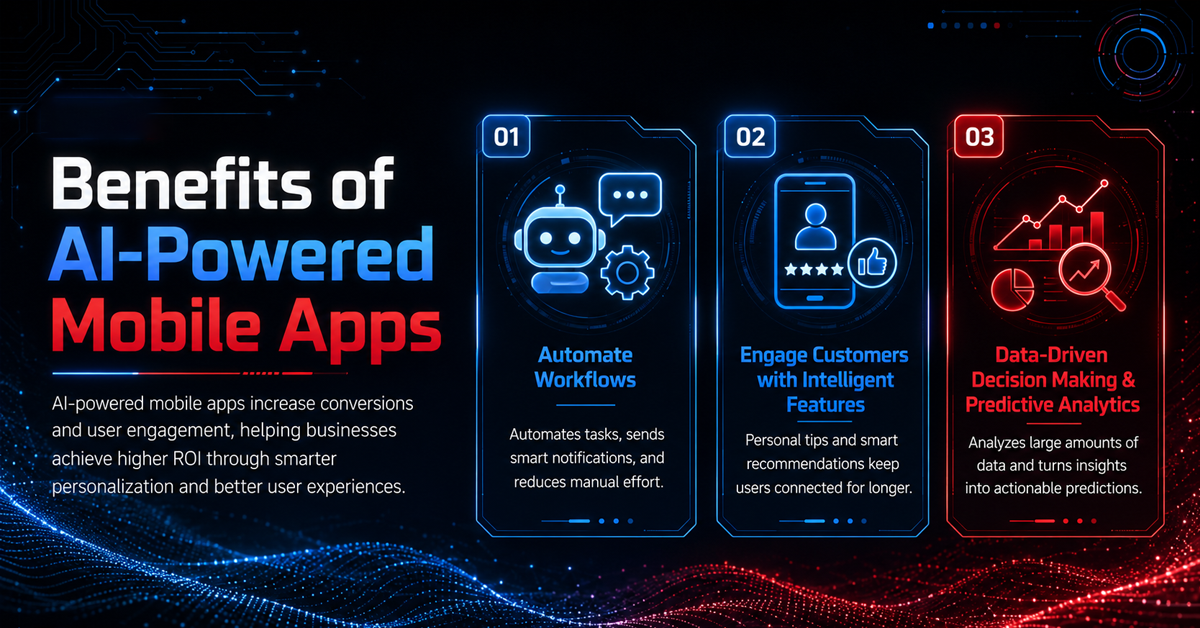
AI-powered mobile apps increase conversions and user engagement. As a result, you get higher ROI. AI mobile app development adds personalization to mobile apps, so it learns user behavior to deliver relevant search results. Below are some of the key benefits of AI-powered mobile apps:
Mobile applications with AI integration automate tasks, allowing you to make potential decisions instead of managing tasks manually. For instance, AI automation sends notifications about important queries and responds via chatbots. This saves your time.
The greatest benefit of AI mobile apps is their ability to engage customers through intelligent features. Offering personal tips and smart recommendations helps users feel connected to the mobile application. Intelligent features work as elements that pop up in apps and engage users for a long time.
Mobile apps consume huge amounts of data; therefore, much time is needed to manage it, and to build business strategy based on it. With AI, this process goes on the fly. Besides collecting and analysing all input data, it also makes predictions you can use right away for mobile app users.
Mobile app development is changing towards something meaningful for people. It is now smarter, faster, and more connected with AI mobile app development. AI and ML are making apps intelligent with information. Low-code and no-code platforms help teams build faster. 5G improves real-time experiences. AR and VR provide immersive virtual interactions while IoT connects apps to your devices. Similarly, with all these modern trends, security and cross-platform development remain essential parts of mobile apps. For businesses planning a new mobile app, now is the time to look beyond basic features and consider what the next generation of mobile experiences can actually deliver. Ready to build a mobile app that keeps up with what’s next? Partner with AdamIS Tech, an AI app development company, to turn your idea into a fast, secure, and user-friendly app.
DELIVERING DIGITAL RESULTS, YOU DESIRE
READY TO HAVE A CONVERSATION?
WE'RE JUST A MESSAGE AWAY!

Define your goals and identify areas where we can add value to your business.
LET'S TALK ABOUT
YOUR PROJECT
Connect with us directly and get personalized guidance every step of the way.